
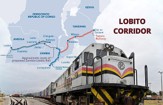
In Kolwezi, in the Bel Air neighborhood, some residents live just a few meters from a railway line set to play a strategic role in transporting Congolese minerals to international markets. Yet, many of them are still unaware of the existence of the Lobito Corridor, a vast railway project backed by several international partners.
Others fear potential expropriations and are demanding guarantees regarding compensation.
John Tshilemb has lived near this railway line since childhood. Despite this proximity, he claims he has never heard of the project.
"I have lived next to this railway since my childhood. I was born and raised in this neighborhood, but I have never heard of the Lobito Corridor. This is the first time I am learning about the existence of this project. We hope that if this project materializes and requires our relocation, we will not be driven from our homes without being compensated. We also hope that this project brings something positive to our neighborhood and the population," he testifies.
This lack of awareness contrasts sharply with the strategic importance placed on this infrastructure. For civil society organizations, informing and raising awareness among local communities must go hand in hand with the project's implementation.
Alphonsine Tshilefe, head of the mining thematic group at the Local Civil Society Consultation Framework of Lualaba, insists on the need to involve the affected populations.
"We know that we have minerals that must transit through this route. What we can ask of decision-makers is to first support the population through information. The population must be informed so that this corridor benefits the community," she urges.
Beyond transporting copper and cobalt, the Lobito Corridor also carries ambitions for regional economic development. Improved trade, market access for agricultural producers, and investment opportunities for small and medium-sized enterprises are among the expected prospects.
However, for Professor Jean-Pierre Mpiana Tshitenge, a sociologist at the University of Kinshasa and author of a study on the geopolitical stakes of this corridor, the project must not be limited to facilitating the export of natural resources.
"The Lobito Corridor must be envisioned as a development corridor and not merely as a corridor for extracting minerals from the DRC and Zambia to the outside world," he emphasizes.
Stretching approximately 1,740 kilometers, the Lobito Corridor connects Kolwezi, in the southeastern Democratic Republic of the Congo, to the Angolan port of Lobito, with plans to link to the Zambian rail network. It constitutes a strategic axis for exporting copper and cobalt, two essential minerals for several global industries.
Supported by the United States, the European Union, the African Development Bank, and several international financial institutions, the project is also part of a broader geopolitical competition over access to critical minerals. Western powers are seeking to diversify and secure their supply chains, as China currently holds a dominant position in the refining of several of these resources.
Written by Noé KALEMEKO