
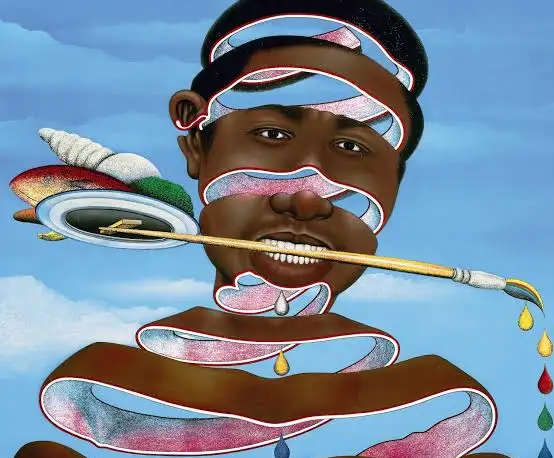
The streaks of paint that run through the walls of Congo tell a story of a revolution towards freedom; freedom from societal expectations and from the challenges of everyday life in the Congo. Where the burden of deep colonial history can be felt, it is difficult to find freedom from the present. Painting and art in general, in the Democratic Republic of the Congo, have become a means to unite cultural identity and transform it into a form of creativity. Through music, murals, and sculptures, people in the DRC have transformed struggle into expression by creating beauty from adversity, serving as a poignant reminder of imaginative resistance.
Much of the significance behind Congolese art can be traced back to its colonial history. As Belgian colonial policies reduced art to solely craft, its cultural significance was stripped and distorted1. Belgian rule introduced an educational system that replaced Indigenous cultural frameworks with European systems, suppressing artistic tradition and restricting creative freedom. After independence, the long past of instability and economic decline left cultural institutions unrecognized and underfunded, creating a gap that required fulfillment through identity and memory2. Modern Congolese artists stepped in to rebuild memory, using rhythm, movement, and expression through art.
Art in modern Congo is an expression of daily life, used to respond to the political and social climate in a subtle yet profound way. It’s a transformative means through which citizens can protest against poverty, conflict, and corruption, while sharing with the world their fashion and aspects of their daily lives3. The nature of Congolese art is commentary and survival in itself; a living archive of resilience that preserves memories and identities. A notable example of this is artist Cheri Samba, whose paintings depict life in Africa. With art pieces such as ‘Water Problem’ (2004) and ‘Hope Keeps You Going’ (1997), Samba notes his art is “a way of not allowing freedom of interpretation to the person who looks at [Samba’s] painting.”4
On the other hand, several music artists from history embrace Congolese rumba, typically aiming at creating music embedded with political commentary. For example, Papa Wemba was a music artist who played Congolese rumba and soukous, a genre of dance music originating from the Democratic Republic of Congo. Called the “King of Rumba Rock,” Wemba not only had an important role in world music, but he also was a fashion icon central in promoting La Sape, a youth movement that promoted fashion to cultural identity for Congolese youth5.
Moreover, Taby Ley Rochereau was another Congolese singer who specialized in African jazz. His music combined indigenous instruments, Latin dance beats, and several western arrangements6. By blending elements from several different cultures, Rochereau became one of the country’s most popular singers. In fact, he even made African music international following the rise in popularity of his band Afrisa International.
Today, Congolese art sits at a crossroad where tradition intersects heavily with global modernity. Artists like Fally Ipupa, Innoss’B, and Maître Gims all embody that combination thoroughly. Together, the sounds of rumba, ndombolo, soukous, Afrobeats, and western pop create a style of music that resonates across the world, far beyond the borders of the Democratic Republic of Congo. Even as bands like Afrisa International or artists like Cheri Samba achieve international fame, their work remains deeply rooted in the cultures and identities of those from home, reflecting the country’s struggles with conflict and political uncertainty. Simultaneously, it emphasizes Congo’s pride and resilience, exemplifying the endless creativity among its native people. Through their music and paintings, artists offer an image of Congo that circulates honesty and hopefulness, proving Congolese music as a cultural force that carries the weight of the promise of a brighter tomorrow.
Written by Vedica Chudiwale
References:
- https://news.artnet.com/art-world/kinshasa-congo-2164769
- https://www.britannica.com/place/Democratic-Republic-of-the-Congo/The-arts
- https://www.on-curating.org/issue-49-reader/painting-in-the-democratic-republic-of-the-congo-culture-and-identity.html
- https://museemaillol.com/en/expositions/cheri-samba-in-the-jean-pigozzi-collection/
- https://www.redbullmusicacademy.com/lectures/papa-wemba-lecture
- https://realworldrecords.com/artists/tabu-ley-seigneur-rochereau/#:~:text=Tabu%20Ley%20Rochereau%20came%20to,electric%20guitars%20and%20westernised%20arrangements.