
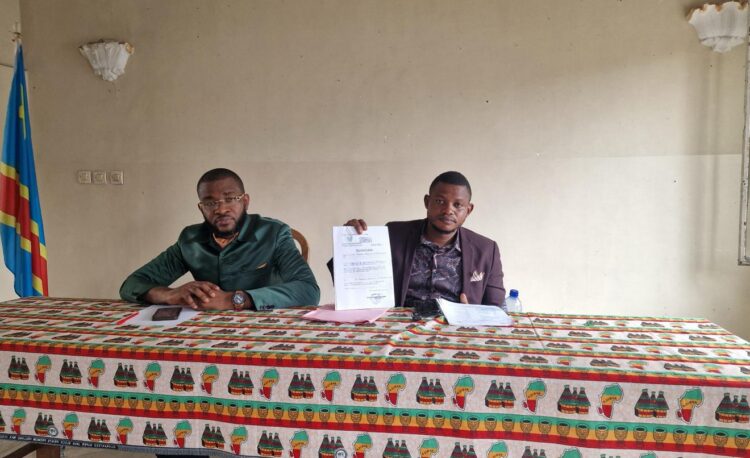
“The Congo no longer has the power to decide on its strategic minerals on its own; it must now do so together with the United States.” With this statement, Jean-Marie Kalonji, coordinator of Quatrième Voie movement and a member of the plaintiffs’ collective, set the tone for a press conference held on Monday, April 27, 2026, at the Andrée Blouin Cultural Center.
At the heart of the discussions was an agreement described as opaque and deeply unbalanced, concluded between the Democratic Republic of the Congo and the United States over strategic minerals such as cobalt, coltan, and lithium—key resources for the global energy transition and the technology industry. For civil society actors present, this agreement reflects a long-standing pattern of extractivism, whereby raw materials leave the country with little added value, benefiting foreign industrial powers, particularly the United States.
From a legal standpoint, the challenge is unequivocal. On January 21, 2026, a collective of lawyers filed a petition before the Constitutional Court seeking to have the agreement declared unconstitutional, arguing that it commits national sovereignty without genuine democratic debate or effective parliamentary oversight. Yet, three months after the filing, no ruling has been issued.
Despite a follow-up request submitted on April 17, 2026, calling for the scheduling of a hearing, the high court remains silent. The plaintiffs interpret this silence as a denial of justice and a sign of the fragility of the rule of law in the face of prevailing geostrategic and economic interests.
“We intend to refer the matter to the International Council for Human Rights as well as other international bodies, as domestic remedies have now been exhausted,” said attorney Valentin Ketshi. This move reflects a growing loss of confidence in national mechanisms for regulation and rights protection.
Beyond the legal dimension, the broader question of the Congolese economic model is being raised. With over 70% of the world’s cobalt reserves, the DRC holds a central position in global supply chains. Yet, the economic benefits for the population remain minimal: limited local industrialization, dependence on raw exports, and rent capture by a small group of actors.
For the initiators of the legal action, this agreement risks deepening these structural imbalances. “This is not merely a legal text, but a political choice that will shape the future of several generations,” they stressed. They are calling for national reappropriation of natural resources through policies promoting local processing, transparency, and accountability.
In this context, their struggle aims to ensure that “the law is upheld in favor of the Congolese people,” whom they believe are once again being sidelined in a decision-making process removed from their fundamental interests.
Written by Pascal Muteba
