
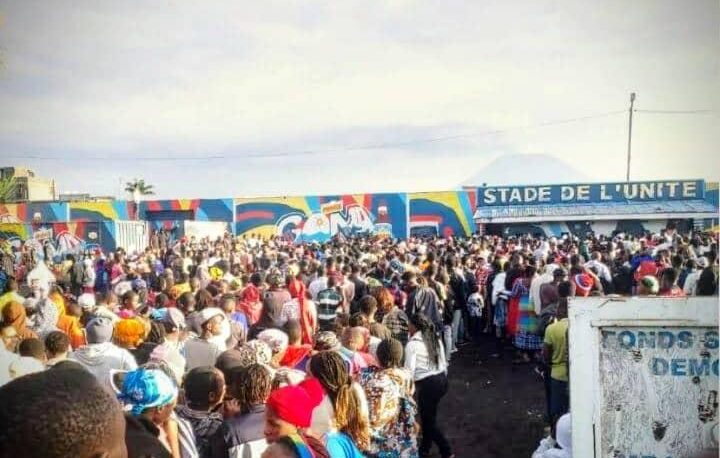
Enthusiasm quickly gave way to disappointment. On Sunday 22 March, hundreds of residents had gathered at the Stade de l’Unité to take part in a raffle; but many left without a draw having taken place.
From early morning, young people, adults and the elderly had bought tickets selling for 2,500 Congolese francs (around one dollar) and were hoping to win prizes. Some had bought several tickets, in some cases as many as ten. On the ground, however, there was no sign of any draw taking place. “We waited in vain,” said one participant bitterly.
Faced with the lack of organization, confusion set in. Families who had invested part of their meagre incomes in buying tickets found themselves with no apparent recourse. The situation, already tense due to the local security context, deteriorated at times: members of the security forces affiliated with the AFC/M23, who control the town, intervened to disperse the crowd.
After waiting in line for several hours, some of the participants became angry. According to witnesses, local residents gathered and protested, with some throwing stones to express their dissatisfaction at what they consider to be a deception.
At this stage, no official statement has been issued by the organizers to explain the cancellation or postponement of the event. Residents, visibly frustrated, left the scene expressing their bitterness. Others went to the organizers’ alleged office in the Les Volcans neighborhood to seek clarification.
This latest episode is part of a series of recent initiatives – raffles, lotteries, informal trading, sports betting and schemes such as Nyendawagira and Otto – which have generated as much hope as they have controversy. For many observers, these practices reflect a search for quick fixes in the face of persistent economic insecurity: unemployment, falling incomes and limited access to formal credit mechanisms.
Psychologists are warning of the cumulative effects of these setbacks: repeated disappointments, a loss of confidence and increased stress amongst a population already suffering from the violence and displacement caused by the armed conflict in the east of the Democratic Republic of Congo. Job losses, exacerbated by economic disruption – notably the closure of certain bank branches and the partial paralysis of activities around the airport – are reinforcing a sense of widespread uncertainty.
“If the war drags on, unemployment will become another form of silent crisis,” worries one observer.
Written By the Team