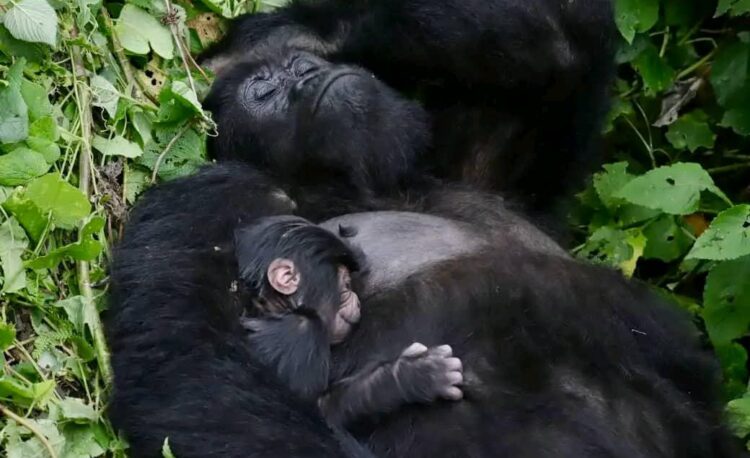
In the east of the Democratic Republic of the Congo, gorilla families are welcoming new births despite the continuing security instability. On Tuesday 17 March, Virunga National Park announced the arrival of a newborn in the Masubo family, bringing the number of births recorded since the start of 2026 to six, spread across five groups.
Formed in October 2025 following a split from the Kibirizi family, the Masubo group is led by the silverback Masibo. “Formed in October 2025 following the split from the Kibirizi family, the group is led by the silverback Masibo, son of Kabirizi, who took 13 individuals with him. This is the first birth recorded since the family’s formation, bringing the troop’s total to 15 members,” the park stated in a post on X (formerly Twitter).
These findings come against a backdrop of severe security instability, which is having a lasting impact on conservation activities. Park authorities highlight the role of community trackers, who are responsible for the daily monitoring of gorillas in an environment that has become particularly challenging. According to the official website of Virunga National Park, at least 110 community trackers are involved in monitoring and protecting the groups. “Behind every confirmed birth lies the patient and dedicated work of our community trackers. Out in the field every day, often in demanding conditions, they are the first witnesses to these exceptional moments,” emphasizes Jacques Katatu, head of mountain gorilla monitoring.
But these encouraging signs struggle to mask the ongoing deterioration of the situation in this protected area, which has been a World Heritage Site since 1979. In a report submitted to UNESCO’s World Heritage Committee in 2025, experts warn of this alarming situation. “The presence of armed groups in and around the park is hampering conservation activities. In 2025, the situation worsened significantly with the advance of M23 fighters near Goma. This insecurity has restricted access to the central and southern sectors of the park for park rangers and scientific teams, thereby complicating the monitoring of illegal activities and regular patrols.”
The report also highlights the indirect consequences of the conflicts. “Human occupation within the protected area is on the rise: the occupied area has increased from 1% in 2021 to 14.2% in 2024, exacerbating human-wildlife conflicts. Other factors such as the intensification of agricultural activities, grazing and infrastructure construction are exacerbating these pressures,” the report notes.
Implications for research:
Despite these constraints, the eco-guards of the Congolese Institute for Nature Conservation are continuing their operations. Land, lake and aerial patrols are maintained in certain accessible areas. “These operations have led to the arrest of around 1,700 people involved in illegal activities, including illegal fishing, farming within the park and charcoal production. Collaboration with local stakeholders is seen as key to reducing tensions and improving conservation,” the report states.
Beyond conservation, instability is also affecting scientific research. A study published in November 2025 in the journal Nature Sustainability highlights that this disruption has led to “the suspension of several scientific programs designed to document local biodiversity, monitor changes in species populations and better understand the ecological dynamics of tropical forests. ”
The authors add: “When insecurity takes hold, research stations close, scientists lose access to study sites, and ecological monitoring programs are interrupted. This situation creates a critical lack of scientific data, making it more difficult to understand and protect ecosystems.”
In April 2025, Virunga National Park celebrated its centenary amidst a wider crisis that extends beyond its borders. Established in 1925 to protect its exceptional biodiversity, the park is now facing a succession of conflicts, human pressures and economic challenges that are testing its ecological integrity.
Written by Victoire Katembo Mbuto