
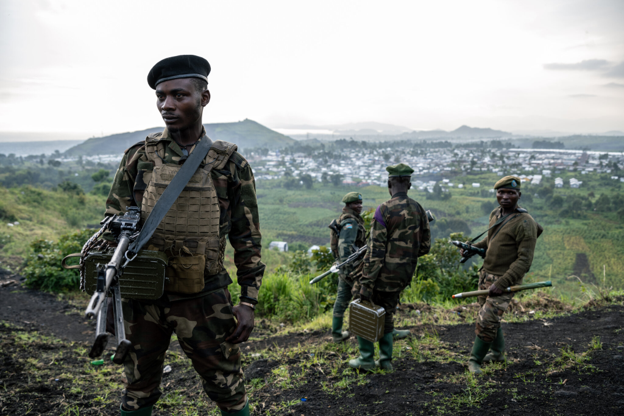
In 2025, the Rwandan funded rebel militia M23 violently charged into Goma and Bukavu in the Eastern Democratic Republic of the Congo, taking the city over from the government, controlling access to the city. The current conflict between Congo (DRC) and Rwanda started in 2021 although there has been tension between these two countries for over 30 years. This tension is illustrated by the conflict between the Rwandan-backed militia M23 and the Congolese armed forces (FARDC). This is a fight for the world’s richest critical mineral reserves, and longstanding ethnic political tensions[1]. In June of 2025 both Congo (DRC) and Rwanda met at the White House to sign an official peace deal entitled “The Washington Accords” (later reaffirmed in December) to end the violence between the two African Nations. The finalization of a peace agreement was publicized across the globe with Presidents Félix Tshisekedi of the DRC and Paul Kagame of Rwanda seemingly legitimizing this diplomatic effort, in addition to both praising Trump. Although, to what extent is this accord going to be effective at preventing conflict, especially since Rwanda and the DRC possess a history of failed diplomatic initiatives (UN Security Council Resolution 2773).
This conflict can be understood as a war for critical minerals. The critical minerals found in the Democratic Republic of Congo are among the most sought-after raw materials due to the vital role they play in the development of modern technologies. For example, lithium is required for electric vehicles and energy storage systems, making it essential for the global transition to green energy. Furthermore, critical minerals are used in the production of permanent magnets, which are necessary for many defense technologies, including fighter jets, lasers, and warships. Overall, critical minerals have significant implications for national security, economic security, and energy security. For the United States, dependence on foreign sources of critical minerals can disrupt defense manufacturing, weaken industrial competitiveness, and slow the transition to clean energy technologies such as electric vehicles, batteries, and renewable power systems. This makes them extremely lucrative and of extreme importance.
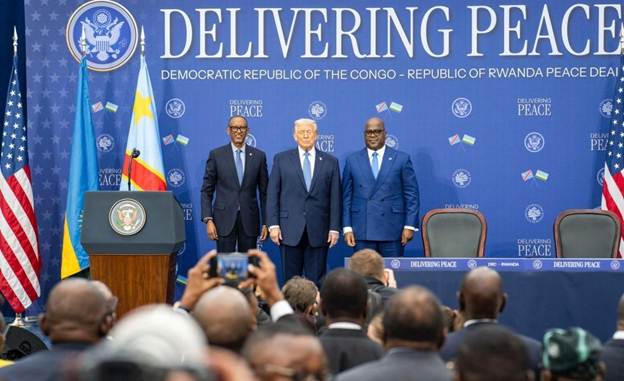
The objective of the Washington Accords is to promote peace and prosperity between the Democratic Republic of Congo and Rwanda. Both countries under the supervision of the United States have committed to peaceful relations, respect for sovereignty, as well as cooperation to ensure the safe return of displaced persons and refugees[2]. President Trump claimed “We’re succeeding where so many others have failed and this has become the eighth war that we’ve ended in less than one year”[3]. Furthermore, the agreement highlights economic integration between both countries. Both countries signed onto the Regional Economic Integration Framework (REIF), which attempts to link the nations economies which would be mutually beneficial, and furthermore deter conflict. For instance, both countries have committed to jointly constructing energy power projects such as the Ruizi III hydropower plant and methane gas extraction from lake Kivu to increase electricity access for families and businesses. In addition, the DRC and Rwanda are seeking to collaborate on tourism; they intend to position the region as a unified, world-class destination for ecotourism. They plan to mutually market Rwanda’s Volcanoes National Park and the DRC’s Virunga National Park as a single, cohesive destination with the assistance of joint visas, and infrastructure. This increased interconnectivity is mutually beneficial for the regional economy, and therefore offers a form of deterrence from conflict.
In contrast, this perceived successful diplomatic effort (Washington Accords) registers as an illusion when encountering the reality on the ground. The Washington Accords means nothing to the victims, survivors, and those engaged in the conflict as there is “currently no ceasefire in place, and the M23 rebellion continues to expand and consolidate its control”[4]. Furthermore, doctors near conflict zones are overwhelmed having to perform back to back surgeries on soldiers, patriotic militias (Wazalendo fighters), and civilians who have been wounded in the militaristic clashes[5]. President Trump’s assertion that his administration ended the war and secured peace in the region is contradicted by conditions on the ground.
Moreover, the Washington Accords represent a departure from previous diplomatic frameworks, undermining the effectiveness of multilateral institutions such as the UN.. This is represented by a significant shift in the diplomatic narrative of the conflict compared to the UN Security Council’s Resolution (UNSC)[6], moving away from the language of international condemnation and towards a narrative of bilateral partnership and economic integration. To illustrate this point, within the UNSC’s Resolution the Security Council explicitly identifies the Rwandan Defense Forces(RDF) as an active participant in the conflict. Condemning the aggressors (RDF) for “direct support and participation” in the capture of major Congolese cities like Goma and Bukavu. The UNSC Resolution frames the situation as a violation of the sovereignty and territorial integrity of the DRC. In contrast, the Washington Accords represents a strong relationship between Presidents Tshisekedi and Kagame centered on “mutual respect” and “cooperation”, undermining multilateral institutions.
The reality is that the United States has secured its supply chain of critical minerals via the bilateral strategic partnership agreement (between the US and the DRC). This agreement was established beyond the Washington Accords yet plays an arguably more important role in terms of its implications for the DRC. In essence, the strategic partnership is meant to ensure secure long term mineral supply security in addition to combating China’s dominance over the critical mineral supply chain. To illustrate this argument, Article II section 8 ( Washington Accords) states the DRC must “facilitate stable, predictable, long-term access for U.S. persons and aligned persons to critical minerals from the Democratic Republic of the Congo to support safety, security, and prosperity for both the United States of America and the Democratic Republic of the Congo”[7]. On top of this, the US will be the majority owner in all the projects that are a part of the agreement. This directly illustrates that the U.S. is locking in long-term supply security where they will maintain a predictable flow of raw ore to continue the production of essential technologies.
Furthermore, Article XI section 1 (Washington Accords) states “the Parties recognize the strategic nature of the Sakania-Lobito Corridor project and that it serves as a key route for the transport and export of copper, cobalt, zinc, and other critical minerals, as well as other commercial goods, from the Democratic Republic of the Congo to the United States of America”[8]. This core infrastructure strategy involved the United States pledging $4 billion under Joe Biden’s administration in order to reduce reliance on the current China-dominated supply chain, working to create a western alternative. The Sakania-Lobito Corridor is a railway project traversing rich mining regions across Angola, the Democratic Republic of Congo, and Zambia. Minerals will be exported out from the Port of Lobito on the Atlantic coast, which will increase the speed at which the US and European markets access critical minerals. This pledge reflects the United States’ heightened focus on securing supply chains for critical minerals, resources that play a pivotal role in the development of technologies from electric vehicles to solar panels to defense systems. It gives the U.S. preferential access to mineral assets over China.
At the re-affirmation of the peace-deal press conference Donald Trump makes it clear that the US’s incentive to get involved in the region isn’t solely about preventing human rights violations but is instead foundationally economic. The DRC is currently sitting on $25 trillion in untapped mineral reserves[9]. Trump wasn’t shy about expressing the deal his administration worked out to access those reserves: “we’re going to take out the rare earth, take out some of the assets, and pay, […] everybody’s going to make a lot of money.[10]” The presence of economic deals coupled alongside humanitarian policy represents a blurry set of priorities for the Trump administration. Furthermore, analysts are sceptical that the Washington Accords will lead to lasting peace. A Congolese researcher with the South Africa-based Institute for Security Studies think-tank, Bram Verelst claimed “the signing ceremony is unlikely to alter this (humanitarian) situation, though there is some small hope it could increase accountability on Congolese and Rwandan leaders to honour their commitments”[11]. This expert account represents the perceived weak effectiveness of the Washington Accords as a solution to the humanitarian violations in the great lakes region.
In essence, the Trump administration’s priorities are represented through the policies being enforced. The failure to tangibly address the atrocities in Eastern Congo expose the Washington Accords summits as deceptive, presented as a humanitarian achievement while ultimately serving to secure a geostrategic critical mineral supply chain. The regional conflict persists till the present between M23 and Congolese national forces. This does not render diplomacy irrelevant; rather, it raises critical questions about whose interests are truly being served and whether sustainable peace can emerge from international intervention that fails to confront the underlying causes of the conflict. In this light, the Washington Accords risk being remembered less as a genuine breakthrough and more as a symbolic gesture. This treaty (Washington Accords) highlights the complexities of modern geopolitics, where humanitarian goals and economic ambitions are often deeply intertwined.
Written by Mitchell Swan
[1] https://horninstitute.org/tracing-the-origin-of-the-tensions-between-the-drc-government-and-the-m23-rebels-in-the-eastern-democratic-republic-of-congo/
[2] https://www.state.gov/joint-declaration-by-the-democratic-republic-of-the-congo-and-the-republic-of-rwanda-on-the-occasion-of-establishing-the-washington-accords-for-peace-and-prosperity/
[3] https://www.nytimes.com/2025/12/04/us/politics/trump-congo-rwanda-leaders-peace-talks.html
[4] https://www.bbc.com/news/articles/cjrjn88jqn4o
[5]https://www.npr.org/2026/02/23/nx-s1-5711634/trump-says-he-ended-the-war-in-dr-congo-but-the-fighting-is-far-from-over
[6] https://docs.un.org/en/s/res/2773(2025)
[7] https://www.state.gov/strategic-partnership-agreement-between-the-government-of-the-united-states-of-america-and-the-government-of-the-democratic-republic-of-the-congo
[8] https://www.state.gov/strategic-partnership-agreement-between-the-government-of-the-united-states-of-america-and-the-government-of-the-democratic-republic-of-the-congo
[9]https://2017-2021.state.gov/bureau-of-international-narcotics-and-law-enforcement-affairs-work-by-country/democratic-republic-of-the-congo-summary/