
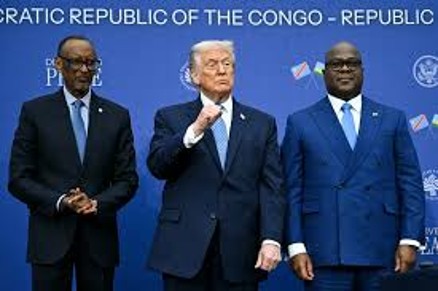
Following the election of Donald Trump as American president in 2024, Trump and the powerful elites around him sought to make deals and agreements covering the American security, political and business interests in the Democratic Republic of Congo.1 This is occurring during a time when the Tshisekedi government is desperate for international assistance in its war against M23 in the Eastern Congo.2 This desperation puts the Congolese government and people in a disadvantaged situation when making negotiations and as shown through many of the agreements signed is negatively impacting security and long-term economic development.
The first agreements signed between the U.S. and DRC came on June 27th, 2026, were listed as a peace deal between the DRC and the Rwanda backed M23 movement however in practice it constituted an example of the business minded transactional contracts that President Trump intended to sign.3 No promises were made by either side to stop the conflict fully the deal only stipulated that the U.S. would receive valuable minerals like cobalt, coltan, gold and tin in exchange for “strategic investment” in both countries which would somehow end the fighting.
After the June deal a larger mineral treaty was signed in December of 2025 called the Washington Agreement.4 This agreement was intended to bring a ceasefire to the current conflict but with neither side willing to lay down their arms as of 5 months post agreement it seems that the real purpose of the deal was again mineral rights.5 The U.S. walked away with first dibs on Congolese mines and promises that mineral extraction and transport would be done via U.S. owned railways. For the U.S. this agreement was a strategic jackpot in securing American mineral stockpiles and further intensifying the ongoing mineral proxy conflict between the U.S. and China.6,7
Enforcement of the treaty has been carried out in limited fashion by sanctioning members of the Rwandan Defense Forces (RDF) as well as former Congolese President Joseph Kabila for their roles in aiding the M23 rebel movement that has been accused of restarting conflict in north and south Kivu.8,9 While this does indicate that the Trump administration currently views the M23 rebels and their backers as the violators of the Washington Agreement by in large this has not shifted the America First focus that has defined current U.S. foreign policy. The America First focus especially as it relates to Africa consists of the belief that all U.S. dealings in the country should be made without consideration for previous values like human rights protection, and democracy promotion in favor of a opportunistic transaction based relationship.
What remains to be seen is if the current pro-Kinshasa lean in U.S. foreign policy will continue throughout the remainder of Trump’s time in office and in a longer term with a potential transition in the Congolese government happening in 2028.
Deals from the Trump administration, however, do not only cover mineral rights but also migrants deported from the U.S. In light of the recent surge in deportations that have been taking place in the U.S. the Trump administration has taken to deporting immigrants to countries they have no connection to.10 One of these is the Democratic Republic of Congo which as of late April 2026 has reportedly accepted the first flights of migrants. This program could rapidly scale up with groups including up to 1,000 Afghans allied with the U.S. government potentially being sent to Congo.11 These deals are again symbolic of the transactional foreign policy the U.S. under Trump seeks to pursue with considerations for human rights or international law being minimal to none for the migrants being shipped to Congo.
While the U.S. government has made large scale agreements with the Congo this should also not overshadow the smaller deals made by American businesses and private military groups. One of the largest recent developments American owned KoBold Metals acquiring the Manono Lithium mine.12 The mine is now set to receive a 1-billion-dollar investment to bring it up to “western standards”. Former Blackwater founder Erik Prince has also used his new company, Frontier Services Group, to sign a private agreement providing security for mines.13
These large-scale deals threaten the artisanal small scale mining industries also. Large amounts of capital are able to more successfully develop mines into profitable ventures that generate increasing profit for those involved. The weakening of the artisanal mining sector may help to alleviate many of the labor exploitations present in these small scale mines but it also takes away a means of financial subsistence for the workers and leaves them without security.
In conclusion, the return of Donald Trump to the White House has given opportunities to the Congolese government and various elites in the country but has come at the expense of human rights and Congolese economic sovereignty. Deals made in the first year or Trump’s new administration have handed over vast riches of the Congolese mining business while doing little to actually bring peace to the Conflict with M23 or ensure the wealth ends up back in the hands of the average Congolese citizen. In addition to these new deals covering migration and coming from oligarchs in the American private sector showcase the increasing willingness of the Tshisekedi to act in compliance with western interests and for the enrichment of large business.
Written by Alec Hennessy
(Image taken from Bloomberg)
References:
- https://africasacountry.com/2026/05/the-new-scramble-for-congo
- https://www.criticalthreats.org/briefs/congo-war-security-review
- https://www.hrw.org/news/2025/07/07/minerals-for-peace-how-to-make-the-rwanda-drc-deal-stick
- https://ourtimepress.com/trump-administration-meddling-in-congo/
- https://www.npr.org/2025/12/22/nx-s1-5649503/trump-announced-a-peace-deal-between-congo-and-rwanda-but-fighting-hasnt-stopped
- https://www.reuters.com/world/china/us-not-funding-congos-100-million-mine-guard-embassy-says-2026-04-28/
- https://www.reuters.com/world/asia-pacific/us-challenges-chinese-control-race-african-minerals-2026-02-09/
- https://www.hrw.org/news/2026/03/03/us-sanctions-rwandan-army-commanders
- https://www.barrons.com/news/us-sanctions-dr-congo-ex-leader-kabila-over-rebel-ties-d3d453b9
- https://www.radiookapi.net/2026/04/20/actualite/revue-de-presse/le-potentiel-migration-le-dispositif-daccueil-suscite-des
- https://information.tv5monde.com/international/rd-congo-plus-dun-millier-dafghans-allies-des-etats-unis-expulses-vers-le-pays-2818664
- https://www.oaklandinstitute.org/featured-report/profit-peace
- https://www.theafricareport.com/381915/erik-prince-returns-to-the-drc-amid-us-mineral-security-push/