
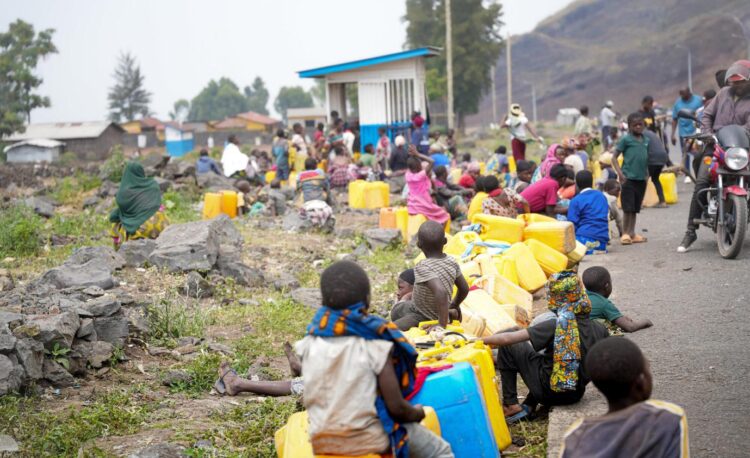
Growing up in Eastern Congo, water was never just water, it was a daily struggle.
Imagine standing beside Lake Kivu, one of the great lakes in Africa, yet walking home with an empty jerrycan
The Congo Basin holds approximately 30%-50% of Africa’s freshwater, a region surrounded by water and yet millions struggle to find a clean cup of water to drink. How is this possible?
If we want to understand the crisis, let’s start from the roots It all started with the war of 1996 or what some people call ‘Africa’s World War’ which has been ongoing for decades now. The conflict did more than disrupt the peace, it destroyed the systems that once delivered water, food and basic stability, and since then water has been a rare commodity.
On top of that, population growth, the harsh realities of climate change, and volcanic eruptions (such as the 2021 eruption that displaced 400,000 people) have all played a part in the ongoing water crisis. To make matters worse, Congo water systems are old, exhausted and crumbling. Some of the pipes that carry water today date all the way back to colonial times. Rusted skeletons of a forgotten era. They leak, they burst, they decay and many have never been replaced. For millions of Congolese, the water that should flow into their homes simply …. Doesn’t
Furaha, a 26 young mother living in a city blessed by the vast waters of lake Kivu, yet she rarely sees clean water in her home. Instead, her family survives on whatever source they can find: the lake, the wells, street vendors, rainwater, anything except through the official water system (REGIDESO) that is supposed to serve them.
She calls water a luxury, something only the wealthy can access consistently, even in a major urban center like Bukavu. And she’s not alone. Every day, thousands of people wake up before dawn to join queues at water holes, hoping to collect just a few liters of water that is still dirty and contaminated.
In the city of Goma, a young man named Baraka, trying to support his family, faces a different version of the same nightmare. His nearest water point is over 30 minutes away. The lines are endless, the wait unpredictable. He spends more money than he can afford just to buy small quantities of water. When the supply cuts and it often does, he goes home empty-handed. Typhoid fever and other diseases have become so common in his neighbourhood.
Then there is Thomas, a family man in Bukavu’s Muhungu neighborhood, who hasn’t seen reliable running water in so long that he’s stopped expecting water to come out of the taps at all.
Every week, he spends a painful share of his income buying water from vendors.
This is the daily reality of countless Congolese in eastern DRC: a country without peace, in economic decline, and a water crisis that forces people to spend the little money they have on something their land has in abundance
And then there are the rural communities, for many villages, water barely arrives at all. Families rely on rivers and springs, untreated, unprotected and often contaminated. But what other choice do they have? It is either drinking unsafe water or going thirsty. And in places where clinics are distant, under-equipped, or simply unaffordable, the illnesses that follow contaminated water become deadly.
When you listen to these stories, you hear the same message over and over again: We are tired. Tired of queueing. Tired of getting sick. Tired of being ignored. Tired of fighting for something as basic as water which we have plenty
Where are the leaders, what are they doing? And how are they caring for the people they swore to serve?
The collapse of water systems also contributes to plastic waste as households rely on bottled water and small plastic sachets sold by vendors. Thousands of plastic containers end up in rivers and soil every day. The environment absorbs the cost of every broken pipe and every failed policy
In the end, the water crisis is not only making people sick but also damaging the environment and deepening climate vulnerability.
REGIDESO,the official government agency responsible for supplying water in Eastern Congo, has repeatedly sent out water that is salty, foul-smelling and most of the time untreated ,putting millions at risk of communicable diseases such as bacterial infections, skin conditions, digestive problems, typhoid fever ,amebiasis ,urinary tract infections(UTIs),gastrointestinal illnesses and cholera outbreaks (a sad reality the region knows far too well)
“We are living in conflict but also dying of thirst” said Mapendo from Nyalukemba in Bukavu. The population is suffering in silence while the leaders remain quiet.
Access to clean water shouldn’t be a privilege, not in a region overflowing with freshwater sources. If the funds meant to serve the people were used transparently and effectively, this crisis wouldn’t be their daily reality. But I guess the problem runs deeper than mismanagement
Some support on the ground is provided by:
– UNICEF and MONUSCO who provided 77 000 litres of fuel enabling 5 pumping stations to restart after they were shut down due to powerline cuts, allowing 700 000 people to receive clean water in Goma based on a report of March 2025,
-OXFAM which is working with partners such as AVUDS (Centre de development integral pour L’Enfant rural (or CEIDER- Centre for the integral development of the rural child) and SOPROP (a civil organization promoting peace and social cohesion) by helping and assisting displaced people with clean water
-ICRCR which is also helping through its Goma West resilient Water project which aims to deliver safe, affordable water to people in Goma preventing waterborne diseases
-IRC (International Rescue Committee) which has been in Eastern Congo for decades now and is also helping through emergency aid and provision of safe water
Call To Action
To anyone reading this, make a change and share these stories, support organizations working on water access, advocate for peace because without peace no infrastructure can survive. The people of eastern Congo deserve clean water.
Written by Vanessa Mukanire