
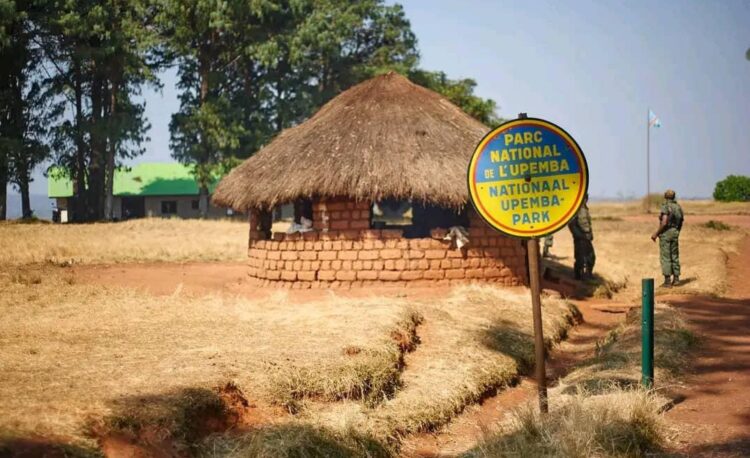
The Congolese Institute for Nature Conservation (ICCN) announced that on Tuesday 3 March, an armed incursion targeted the headquarters of Upemba National Park, located in Lusinga, in the province of Haut-Katanga. The attack, attributed to “unidentified” assailants, resulted in the deaths of five staff members and significant material damage.
In an official statement signed in Kinshasa on 4 March 2026 by its Director General, the ICCN stated that “the headquarters of Upemba National Park, located in Lusinga, was the target of an armed incursion perpetrated by a group of unidentified assailants” on Tuesday 3 March 2026.
In response to this attack, the management of the public institution in charge of protected areas claims to have reacted without delay. “Under the leadership of the Director General of the ICCN, a crisis unit was immediately convened yesterday morning,” the statement said. The institution added that “in consultation with the sovereign forces, in particular the Armed Forces of the Democratic Republic of Congo (FARDC) and the security services, a series of measures has been activated to ensure the safety of agents and executives, in accordance with human rights and international standards.”
According to the same source, the security situation is now under control. “At this time, full control of Upemba National Park and Lusinga station has been restored by the defense and security forces,” the ICCN reassures.
However, the attack has left deep scars on this protected area, considered one of the country’s major biotopes. The statement gives a heavy human and material toll, with “five park staff tragically losing their lives; equipment looted; and infrastructure suffering significant destruction”.
The institution strongly condemns this attack, which it describes as a serious violation of national and international norms. “The ICCN condemns in the strongest possible terms this flagrant violation of the national legal order and international conventions. This act constitutes a direct transgression of the principle of neutrality and non-belligerence governing protected areas, which are considered common heritage of humanity under international environmental law,” the statement emphasizes.
This attack comes amid a still fragile security situation in several areas of the country, where protected areas are regularly exposed to threats from armed groups, poaching and illegal exploitation of natural resources.
Written by Franck Kaky