
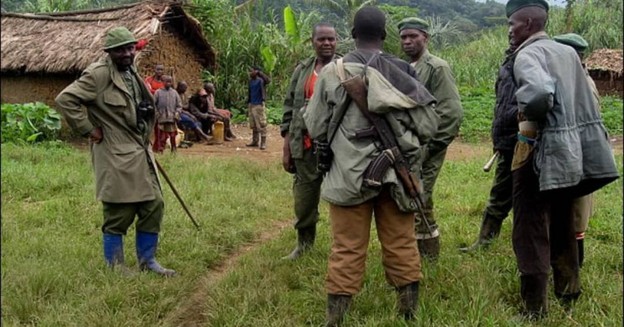
The International Contact Group on the Great Lakes Region, chaired by France, welcomes the signing, on 28 July, of a protocol on disarmament, demobilization and cantonment by a faction of the Democratic Forces for the Liberation of Rwanda (FDLR).
It nevertheless urges the Congolese government to adopt “without delay” an operational plan and a precise timetable with a view to the effective neutralization of this armed group, in accordance with the international commitments entered into by the Democratic Republic of the Congo.
In a statement published on Thursday, the eleven member states of the GCI – namely the United States, Belgium, Canada, Denmark, the European Union, France, Germany, the Netherlands, Sweden, Switzerland and the United Kingdom – stated that they take note of this progress. They consider, however, that it will remain insufficient unless it is followed by concrete action on the ground.
The GCI urges Kinshasa to draw up a credible operational framework, in line with the Washington Agreements of 27 June 2025 and the Protocol on the withdrawal of forces and the lifting of defensive measures by Rwanda, known as CONOPS, dated 31 October 2024.
The group also emphasizes the need for the Congolese authorities to clarify the mechanisms for combating impunity set out in the protocol. It further recommends close collaboration with MONUSCO, described as a “key partner” in implementing the process.
The GCI warns against any form of “co-location or operational cooperation” with elements of the FDLR. Such an approach, it stresses, would be “fundamentally incompatible” with the commitments made under the Washington Agreements.
The Contact Group for the Great Lakes Region calls on all parties to the Washington Agreements and the Doha Framework, as well as the various mediation initiatives, notably that of the African Union, to continue their efforts towards the full implementation of the commitments.
It further reiterates the obligation on the warring parties to protect the civilian population, to comply with United Nations Security Council Resolutions 2773 and 2808, and to scrupulously respect the sovereignty and territorial integrity of the DRC. It urges them to “immediately defuse” tensions.
On a more positive note, the GCI welcomes the prisoner exchange agreement concluded between the DRC and the AFC/M23, facilitated by the International Committee of the Red Cross. It regards this gesture as an “essential confidence-building measure” towards a return to calm.
Finally, the GCI urges all parties to the conflict to respect international humanitarian law and to guarantee “full, safe and unimpeded” access to humanitarian aid in order to provide assistance to the affected populations.
By the editorial team