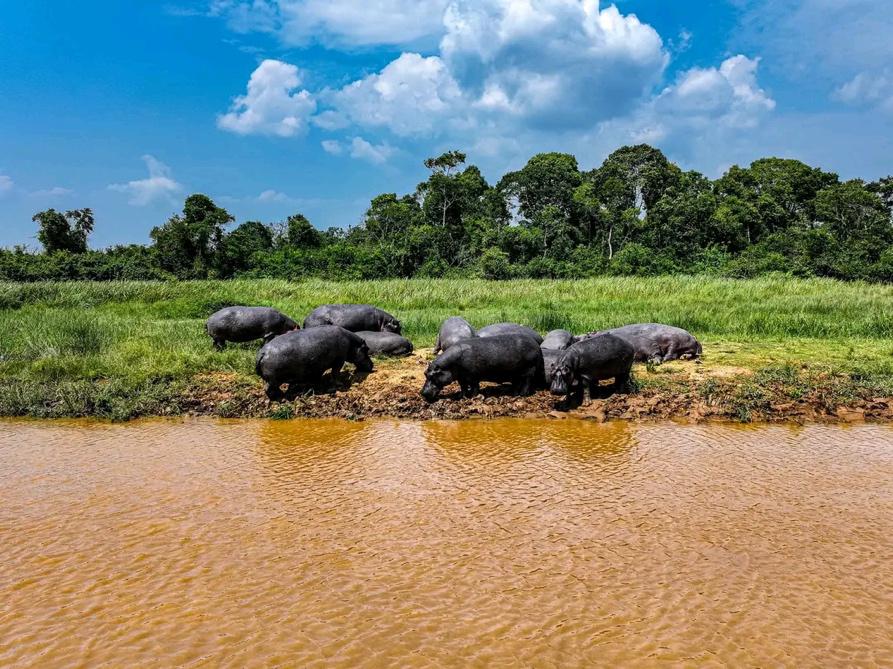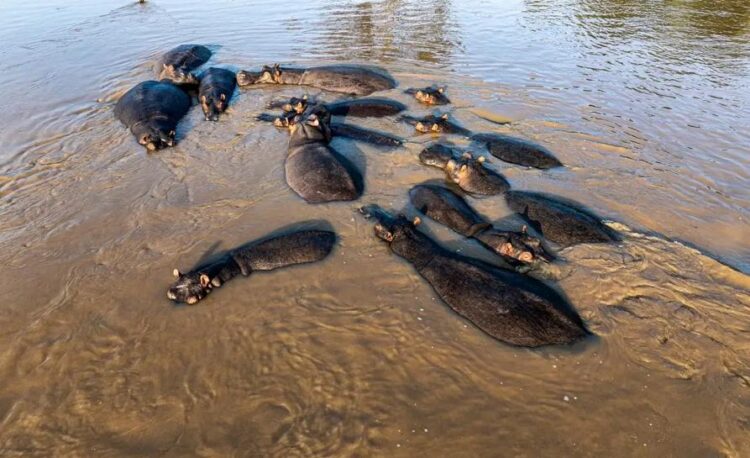
Virunga National Park has announced that 153 juvenile hippos have been counted within 171 groups observed in the southern areas of Lake Edward. This is seen as encouraging news in a region where the species has suffered one of the continent’s most severe declines.
In a statement released on its digital platforms, Virunga National Park emphasises that the presence of these young individuals could indicate a gradual recovery in reproduction, following several years of sharp decline.
A historic collapse in populations
In the 1970s, the park’s hippos constituted one of the world’s largest populations, with around 29,000 individuals concentrated around Lake Edward. Since then, their numbers have fallen by nearly 95%, due to the combined effects of massive poaching and chronic insecurity in the east of the Democratic Republic of the Congo.
According to recent data from the park, the population is now estimated at around 2,700 individuals, a level that remains fragile despite a trend towards stabilization. The park states that this development reflects “the combined effect of conservation efforts, increased ranger patrols and the use of new technologies”, the announcement highlights.
An ecological indicator beyond the species itself
Beyond the issue of biodiversity alone, the presence of hippos is often seen as an indicator of the health of aquatic ecosystems. Their role in the nutrient dynamics of Lake Edward fuels hopes of a positive indirect impact on fish stocks.
For some local environmentalists, this development is an encouraging sign. “When hippopotamus numbers increase, it often reflects an improvement in the lake’s ecological balance,” says a conservation activist from the fishing enclave of Vitshumbi, over 100 kilometers from the city of Goma, clearly pleased.
Within the fishermen’s associations, the news has also been received with caution but interest. Some see a potential positive impact on the lake’s productivity, whilst others are already discussing the possibility of further developing ecotourism in the region. “We’re going to make the most of nature’s wonders. Visitors will come from all over to see them, and this will restore a sense of pride to our village,” enthuses Atanaze Kambale, a 40-year-old fisherman.
Persistent vulnerabilities
This momentum, however, comes against a backdrop that remains unstable. A recent zoonotic disease led to the death of 26 hippos a few months ago.
Many researchers believe that this trend can only be consolidated through greater involvement of local communities. They argue that conservation cannot be effective without shared resource management and awareness-raising regarding health and environmental issues.
“Hippos play a key role in the lake’s ecological balance. Their protection must involve local communities. Stability in the region is also vital to maintaining this momentum. The ICCN must tackle poverty to prevent the resurgence of armed groups that view hippopotamus poaching as a source of income,” emphasizes an expert who requested anonymity.
Written by Victoire Katembo Mbuto