
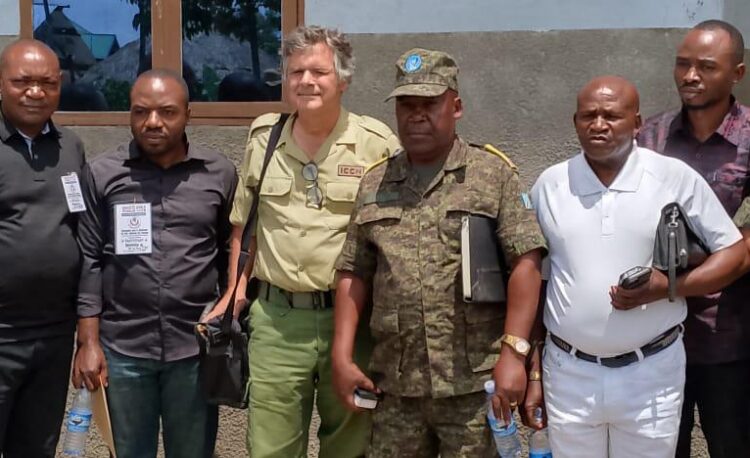
The Provincial Director of Virunga National Park, Emmanuel de Merode, met with representatives from various sections of the population in the Kyavinyonge fishing enclave, on the northern shore of Lake Edward in Beni territory, to discuss the ongoing tensions between the park and local communities on Tuesday 7 April 2026.
For nearly twenty years, the Kyavinyonge fishery, located in the Bashu chiefdom, has experienced friction with the park rangers. The population highlights difficulties linked to living conditions, land disputes and a lack of dialogue with park managers. “A frustrated population cannot support environmental protection,” laments Delphin Kakule Malekani, president of the local civil society group Forces Vives.
According to him, the lack of consultation fuels misunderstandings, particularly with the Virunga Fisheries Cooperative. He calls for the communities to be involved in decisions concerning their future. “Unemployed young people become vulnerable to insecurity. Employment strengthens peace and stability. Without land security, there can be neither peace nor sustainable development,” he insists.
Civil society actors are also calling for close collaboration between eco-guards and local communities to build trust in biodiversity conservation. They highlight several challenges, including a lack of electricity, dependence on firewood, limited economic development, dilapidated roads and a lack of access to clean drinking water.
For Delphin Malekani, the local population must be seen as “a solution, not a threat” to conservation. He also recommends establishing support mechanisms for families affected by attacks from wild animals, particularly crocodiles and elephants. “People protect the environment when they see the benefits. Involving the local population in decision-making is essential. Management of Nile crocodiles: consider classifying them as an invasive species under the law. Reject the option of electric fences,” adds this civil society representative.
For his part, Emmanuel de Merode pointed out that Kyavinyonge is part of the Kivu-Kinshasa Green Corridor vision, a program aimed at strengthening food security through sustainable fisheries management. “Environmental protection ensures the proper management of natural resources, particularly fisheries. It is necessary to maintain order in fishing activities to maximize production,” he explained.
The director also emphasized the role of the Congolese Institute for Nature Conservation (ICCN), pointing out that its staff are not authorized to accept money. He encouraged the public to report any instances of corruption.
Emmanuel de Merode announced the establishment of a working group comprising 12 members from various sectors of society and representatives of the ICCN. Its task will be to propose, within two months, concrete solutions for the drafting of a fisheries development plan.
“Let Kyavinyonge be a pilot project. Despite the security challenges, we can make progress together,” he reassured, emphasizing the importance of a sustainable dialogue between conservation and local development.
According to local stakeholders, these discussions represent an important step towards mutual understanding based on trust and the search for sustainable solutions that benefit both the local population and conservation.
Written by Victoire Katembo Mbuto