
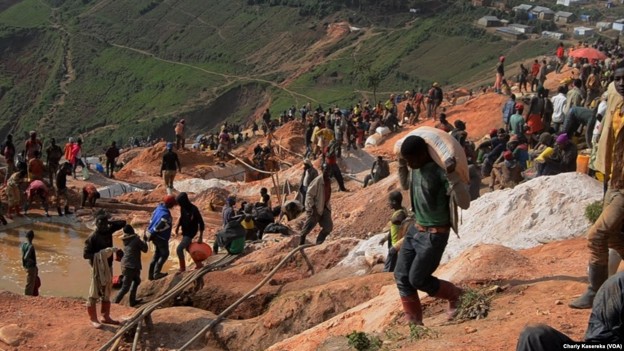
In the Masisi territory of North Kivu, insecurity and population displacement are exposing children to heightened vulnerability. In Rubaya, where the AFC/M23 armed group exercises control, mining conditions and human rights abuses documented by rights organizations are raising grave concerns.
In Rubaya, Masisi territory, North Kivu, the security crisis is not limited to armed clashes and population displacements. It also raises questions about the fate of civilians forced to survive in an environment where artisanal mining takes place under the control of an armed group.
Among the vulnerable populations are children from families displaced or weakened by the conflict. Deprived of resources and facing difficulties accessing education and humanitarian aid, some risk turning to mining sites to meet their basic needs.
Under these conditions, mining work can become a survival strategy with particularly heavy consequences for minors deprived of protection and prospects. The risks are manifold: accidents, exposure to dust, heavy lifting, injuries, and dropping out of school.
Survival at the expense of childhood
In Rubaya, economic hardship and the worsening security situation exacerbate the vulnerability of civilians. For displaced families, the search for food and income can take precedence over children’s education.
“They lack everything, including education. They take advantage of and prefer working in mining sites to meet this need for survival,” confides a local civil society source, speaking on condition of anonymity.
This testimony highlights a troubling pattern: when livelihoods disappear and protection mechanisms are insufficient, children can be pushed into dangerous activities.
The reported presence of pregnant women among those performing hard labor at mining sites also illustrates the extent of the precariousness described by local actors.
These situations warrant thorough field investigations, notably to establish the scale of child labor, their working conditions, and the drivers leading them to join mining sites.
Perimeter PE4731 at the center of concerns
The mining perimeter associated with Rubaya, particularly the former PE4731 concession, is at the center of concerns regarding diggers’ safety and control of the mineral trade.
The situation in this area has already been documented by several sources. In September 2026, Amnesty International published a briefing detailing human rights abuses committed by the M23 in a coltan mine near Rubaya. The organization notably reported summary executions, acts of torture and ill-treatment, arbitrary detentions, forced labor, forced recruitment, and looting.
These findings reinforce concerns regarding civilian protection in mining areas under armed control. However, on their own, they do not confirm every specific allegation regarding the use of children at the site mentioned by the local source.
“They are the ones managing, coercing, and using these children and women to maximize the extraction of strategic minerals from the region,” states the civil society source.
These allegations, which directly implicate armed actors present in the area, call for independent investigations to identify those responsible and establish the facts.
Sovereignty put to the test
Beyond working conditions, the situation in Rubaya raises questions about the control of natural resources in conflict-affected territories.
The civil society source describes an environment in which Congolese populations reportedly have little say over the rules governing their daily lives and the exploitation of their land’s resources.
“In Rubaya, it is the Rwandan norm that is respected here; Congolese represent nothing,” the source asserts.
This testimony reflects the feeling of abandonment and dispossession expressed by certain local actors. It must be viewed within the broader context of AFC/M23’s control over Rubaya and documented concerns regarding cross-border mineral trafficking.
In a report published in 2025, the United Nations Group of Experts had already described the control exercised by AFC/M23 over mineral production and trade in the region, as well as smuggling networks connecting Rubaya to Rwanda
The issue thus goes beyond the mining sector alone: it touches upon state authority, community protection, and the ability of Congolese institutions to ensure that the country’s resources benefit its population.
Protecting children, restoring state authority
Faced with this situation, local civil society calls on the Congolese government and the international community to act to protect civilians and put an end to the exploitative practices denounced at mining sites.
Priorities include strengthening child protection, returning out-of-school children to the classroom, providing access to humanitarian aid for displaced families, and combating forced labor. Securing mining sites and ensuring mineral traceability also remain major imperatives.
In Rubaya, mineral wealth stands in stark contrast to the precariousness of the populations living near extraction areas. As long as security, child protection, and fundamental rights are not guaranteed, the risk remains that the most vulnerable will continue to pay the human price of a conflict-driven mining economy.
Written by Azarias Mokonzi