
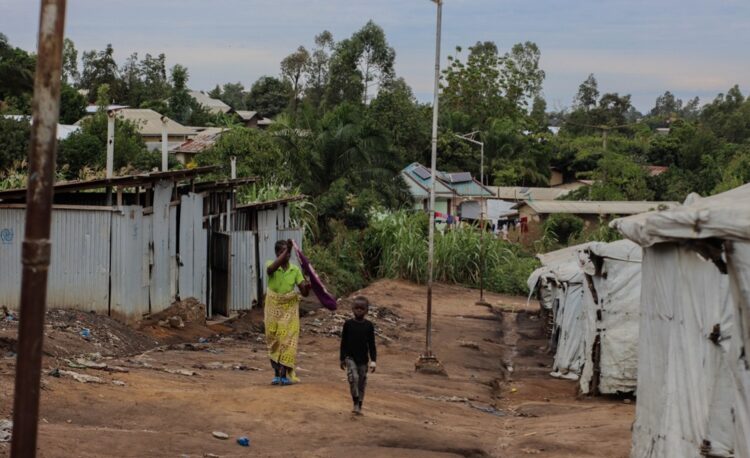
The situation is becoming a cause for concern at the Kigonze site in Bunia, Ituri Province, where nearly 19,000 displaced people are sheltered. Several families have begun to leave the site following security incidents reported throughout the month of September.
According to local sources, the army has repeatedly conducted sweeps of the site, apparently in search of weapons or military equipment associated with the CRP rebellion. During these operations, huts were reportedly set on fire. Feeling unsettled, several families are said to have left the site. Others are said to have returned directly to Djugu, their region of origin, despite the security concerns that had prompted them to seek refuge in Kigonze.
This situation is all the more concerning given that the Humanitarian Coordinator in the DRC, Damien Mama, has himself expressed his “deep concern” in a statement.
“The dispersal of families and restrictions on access risk complicating epidemiological surveillance and disease control. Every family that leaves the site without follow-up potentially becomes a link that slips through the cracks of public health monitoring,” say health sources in the city of Bunia.
In light of the difficult conditions faced by many families at this site, the bishop of the Diocese of Bunia, Monsignor Dieudonné Uringi, is calling for solidarity with those affected by this situation.
In particular, he invites “people of good will to offer their support to displaced families, especially women and children, who are considered among the most vulnerable in this context,” he says. This appeal is directed both to the faithful of his diocese and to the entire Ituri community, at a time when the needs of these families continue to grow.
A meeting was held on September 29 between the military governor of Ituri, Major General Gaby Kasongo, and leaders of the province’s main community organizations.
According to data cited in the press release, more than 1.1 million people are currently displaced in Ituri due to conflict and violence. Of these, more than 373,000 are living in displacement camps.
In the book *Kigonze: The Objectification of Humanity*, written by Professor Chelo Dhebbi, a faculty member and researcher at the Higher Pedagogical Institute of Bunia (ISP/Bunia), the author recounts the events that took place at the Kigonze displacement site. He condemns these operations, citing their human and economic consequences for a segment of the population already in a critical situation.
The Honorable Samy Ufoyrwoth Jakwong’a, president of the Ituri Provincial Assembly, bluntly addressed three situations he considers particularly concerning regarding the security operations being carried out at the Kigonze displacement site.
The elected official reiterated that “a site for displaced persons must remain a strictly civilian and humanitarian space. No combatants, weapons, ammunition, or military or criminal activities should find refuge or protection there.” He called on anyone carrying a weapon to “refrain from using displaced populations as cover, human shields, rear bases, or means of concealment.”
While acknowledging the state’s duty to seek out and neutralize infiltrated armed elements, he emphasizes a principle he considers fundamental: “The presumed or confirmed presence of a few armed individuals cannot turn the entire displaced population into suspects, nor justify their stigmatization, their equating with an armed group, or any form of collective punishment.”
Referring to the consequences of the operations carried out on the ground, he notes that “the available information points to families being scattered, shelters abandoned or destroyed, loss of property, and fires—the full circumstances and responsibilities for which still need to be clearly established,” and calls for “sufficiently detailed official information” as well as thorough investigations into allegations of looting.
Questions that await answers:
Will the army confirm that these lockdowns took place and explain their legal basis? What exactly was it seeking, and what conclusions has it drawn from the operation? Were the huts set on fire during these operations, and by whom? Where have the displaced families gone, and who is ensuring their protection and providing them with medical care? As long as these questions remain unanswered, they will continue to fuel controversy and fear.
Written by Akilimali Chomachoma in Bunia