
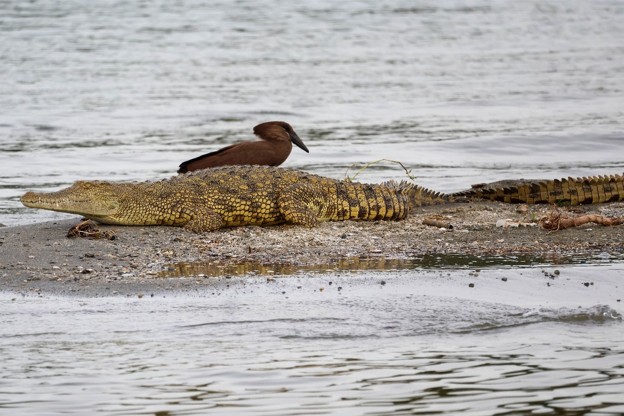
Situated on the northern shore of Lake Edward, at the mouth of the Semuliki River, Ishango Beach – in the northern sector of Virunga National Park, in the Semuliki Valley to the east of Beni territory in the east of the DRC – faces serious environmental threats. Once vast and stable, this iconic beach is now suffering from accelerated lateral erosion and a gradual shift in the river’s course – direct consequences of the severe degradation of the riverbanks, according to reports. Degradation of beaches and sandbanks. Increased erosion of exposed beaches. Compaction of the sand due to human activities.
Ishango’s sandy beach is also recognized as a stopover and resting place for migratory birds, as well as for numerous species of birds, elephants, hippos and amphibians in Virunga National Park. Its sandy, open riverbanks play a vital role in regulating the climate, according to scientists. It was here that, in 1950, prehistoric human bones were discovered, commonly known as the Ishango Man – the famous Ishango Bone, an artefact dating back more than 20,000 years and considered one of the oldest known examples of mathematical reasoning to date.
As a result, this site within Virunga National Park attracts researchers, historians and tourists, all fascinated by the scientific and symbolic significance of these discoveries for the history of humankind. However, environmental activists and conservationists are now warning of a growing threat: the erosion of Ishango Beach is accelerating. This phenomenon, exacerbated by climate change and certain human pressures, risks causing the gradual disappearance of this sandy strip that protects the site. Ultimately, the very integrity of this historical heritage could be compromised. Some scientists believe that this situation is due to pollution in Lake Edward, from which the Semuliki River rises. This degradation is thus contributing to rising water levels.
These natural processes, further exacerbated by human activities in the Semuliki Valley – located in the northern sector of Virunga National Park – are, according to some scientists, exposing the Ishango wetland ecosystem to increased risks of flooding and desiccation. The Semuliki River, which links Lake Edward to Lake Albert, is gradually encroaching on certain sections of the shore.
Local sources, particularly in Kyavinyonge, a fishing enclave situated nearly 8 kilometers from Ishango, point out that uncontrolled deforestation and overgrazing are among the main contributing factors. Environmental campaigners fear that accelerated silting and sedimentation will transform certain areas of light-colored sand into marshy areas, which are less favorable to biodiversity, particularly for migratory species.
The gradual disappearance of Ishango Beach would thus pose a twofold challenge: the loss of a key ecosystem for the biodiversity of Lake Edward and the degradation of a world-renowned heritage site. For more than two months, the Virunga National Park authorities have been carrying out an operation to combat illegal logging, particularly in the Semuliki Valley, an area where human activities have already reached alarming levels. “We have been carrying out this operation for about ten days. More than 60 lorries have been seized in and around the Semuliki Valley. Sixty lorries full of planks and charcoal: just imagine what that means in terms of felled trees,” says Bienvenue Bwenge, communications officer for Virunga National Park, before adding.
“We are in the Semuliki catchment area to deter large-scale destructive activities in Virunga National Park, in particular charcoal production and the felling of trees for timber. These are illegal activities carried out within the Park, acts that are strictly prohibited by law. Some of these practices are irreversible and have considerable negative impacts on the environment.”
The same source explains that this ongoing operation is therefore aimed at deterring these illegal activities, particularly deforestation. “We are targeting those who engage in charcoal production and the manufacture of planks from trees within the Park, and we want to put a stop to this. These are trees, some of which are over a hundred years old. Once they are felled today, there is no going back. The Congolese Institute for Nature Conservation, supported by the provincial security services, is carrying out operations on the ground to deter these environmental criminals,” he adds.
Scientists believe that efforts to combat deforestation in this valley are helping to preserve the environment around Ishango Beach. However, he calls for action to tackle water pollution in Lake Edward in order to mitigate this threat. He advocates for scientific monitoring and the involvement of local communities in protecting this ecosystem. He emphasizes the need for strict protection of Ishango’s riverbanks and sensitive areas.
Written by Victoire Katembo Mbuto