
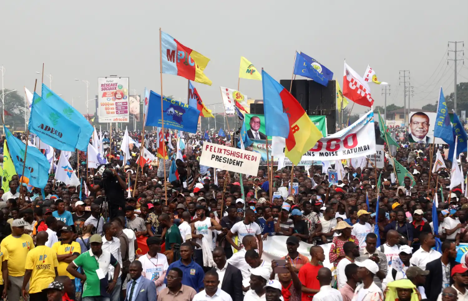
Following the 2023 Congolese General Election and the widespread violence and accusations of election fraud, Felix Tshisekedi began a second term as president of the Democratic Republic of Congo (DRC).1,2,3 His coalition party, the Sacred Union of the Nation (Union Sacrée de la Nation) secured sweeping supermajorities in the senate and national assembly and he personally claimed to win the presidential election with over 75 percent of the vote.4 One of the opposition parties, Ensemble reported having their protests outlawed and suffered police and electoral crackdowns.5 In the actual election their presidential candidate Moise Katumbi only received around 18 percent of the vote centered largely around the Katanga region as he was previously the governor there.6
While Tshisekedi was able to retain control through the election, the pattern of ballot fraud, intimidation and voter suppression has continued to set the stage for the next upcoming Congolese elections especially the 2028 general election. Perhaps the largest electoral issue is the constitutional changes proposed by Felix Tshisekedi that would allow him to ignore the constitutionally mandated term limits and run for a third term as president.7 This first was brought up by Tshisekedi in May 2026 who said, “I have not asked for a third term, but if the people want it, I will accept”.8 This language combined with legislation from his allies in the national assembly to change the constitution means that the threat is real of a repeat of Joseph Kabila’s 2016 attempt to remain in power past his 2016 end of term.9 The justification for overturning the constitution that was provided was that the current conflict between the DRC and the M23 rebel movement in the Eastern Congo around Kivu.10[GU1] This is despite the fact that the 2023 general election was also held during a period of escalated conflict with the rebel group.
The attempt to change the constitution has given new hope to the country’s opposition coalitions that they may be able to defeat the incumbent Tshisekedi.11 The constitutional challenge and opposition resistance ultimately proved enough to topple Joseph Kabila if historical precedent is an indication of the power of opposition. That being said there should be some words of caution to the would-be opposition to Felix Tshisekedi.12 The first is that they have increasingly been targeted by the state apparatus in political crackdowns.13 Not only has the parties of former president Joseph Kabia been banned on national security charges but new opposition groups like that of Moise Katumbi and Martin Fayulu are also under state surveillance with their events being suspended and targeted by violence. Opposition groups also face a challenge if they are able to win control of the government. Being able to successfully govern in Congo would prove difficult even without the likely resistance from Tshisekedi loyalists still in positions of power.
Another consideration is the role of the various churches in the electoral process in Congo.14 The Catholic church as the representative of the majority of the population carries significant weight in Congolese politics. In 2018 the Catholic leadership was the loudest voice calling for the 2018 elections to not be delayed.15 The church is a certified election observer and often inserts itself where it believes that democratic process is in danger to help facilitate protests or other methods of resistance.16 When dealing with the Tshisekedi government the church has often criticized executive power grabs such as the current effort to remove term limits.17,18 It is possible that in the future the Catholic church could come out as a vital endorsement or source of support for the opposition like it was in pervious times under more autocratic Congolese governments. While being a predominantly catholic country there are also various mainline and evangelical protestant groups that have large sway in communities.19 Some of the mainline protestant groups are in line with the Catholic church in social organization and protecting democracy however similar to the experience in Latin America there is also significant friction between long established Catholic views on social issues and new Evangelical protestant churches.20 Recently the Congo has seen a surge in “born again” or revivalist evangelical protestant churches that are largely non-denominational and allied to the conservative state administration. President Tshisekedi has even openly courted the support of this more conservative interpretation of Christianity to balance out his declining support among Catholics.21 While evangelical Christianity has been in the Congo since Swedish missionaries in the 1800s the recent rise of evangelical conservative churches has been in part funded and supported by the same American religious organizations that sought to promote evangelical Protestantism in opposition to Catholic liberation theology in places such as Latin America. This increasing religious polarization in the Congo between a democratic minded Catholic and mainline protestants and a conservative state supporting evangelical base is likely to further divide Congolese society and could be a significant source of friction in the 2028 election.
While religion is likely to be a source of division for the country in the upcoming election, a potential unifier is the countries’ participation in the world cup this year. Congolese victory over Jamacia in the world cup qualifiers was momentous occasion in the country as it heralded the return of the Congo to the world cup after 52 years of tournament absence.22 On their return the players were gifted land, vehicles and other prizes to celebrate their occasion, however, some see potential for more than just a sports victory to come out of the occasion.23 President Tshisekedi has been speculated to be using the opportunity as a rallying cry for the current Congo administration perhaps by visiting the team during their first game in Houston. The reason for visiting the team would most likely be to associate himself and his party with the current source of national pride for average Congolese citizens ahead of elections.
In conclusion the Congolese general elections of 2028 are set to mark a turning point in the countries’ history no matter the result. Following the likely fraudulent 2023 election it marks a vital test for the democracy of the country and especially if presidential term limits are amended could mark the potential end of the current fragile experiment with democracy in the DRC. Various factors such as the opposition unity, religious divide, and world cup unity are set to take the stage and all play vital roles in deciding the future of Africa’s heart.
Written by Alec Hennessy
References:
- https://www.crisisgroup.org/qna/africa/democratic-republic-congo/dr-congo-full-plate-challenges-after-turbulent-vote
- https://acleddata.com/report/disorder-and-distrust-ahead-2023-elections-democratic-republic-congo
- https://africacenter.org/spotlight/elections-democratic-republic-congo-drc-crisis-legitimacy/
- https://data.ipu.org/parliament/CD/CD-LC01/election/CD-LC01-E20231220/
- https://www.hrw.org/news/2023/08/22/dr-congo-crackdown-opposition-ahead-elections
- https://www.reuters.com/world/africa/congo-opposition-candidates-plan-presidential-election-protest-2023-12-23/
- https://www.africanews.com/2026/05/20/opposition-coalition-challenges-tshisekedi-over-possible-constitutional-reform-in-drc/
- https://www.reuters.com/world/africa/congo-president-raises-prospect-third-term-vote-delay-angering-opposition-2026-05-07/
- https://www.hrw.org/news/2016/12/16/dr-congo-kabila-should-commit-leave-office
- https://www.cfr.org/global-conflict-tracker/conflict/violence-democratic-republic-congo
- https://www.africanews.com/2026/05/20/opposition-coalition-challenges-tshisekedi-over-possible-constitutional-reform-in-drc/
- https://www.npr.org/2018/12/11/675522343/after-17-year-presidency-congos-joseph-kabila-to-step-down
- https://www.idea.int/democracytracker/country/democratic-republic-congo
- https://www.africanews.com/2024/01/05/dr-congo-catholic-protestant-churches-demand-inquiry-before-acceptance-of-results/
- https://repository.up.ac.za/server/api/core/bitstreams/f55ff1be-266e-413b-93b4-e009435ba050/content
- https://cic.nyu.edu/wp-content/uploads/2022/10/report-crg-ebuteli-the-catholic-church-in-drc.pdf
- https://thegreatlakeseye.com/post?s=DRC–Catholic–Church–on–collision–course–with–Tshisekedi_1612
- https://cruxnow.com/church-in-africa/2026/03/dr-congo-bishops-warn-presidents-power-grab-could-ignite-further-violence
- https://www.thearda.com/world-religion/national-profiles?u=57c
- https://www.globalministries.org/the_church_of_christ_in_congo_ecc_and_protestant_ecumenism_in_the_democratic_republic_of_congo_drc/
- https://www.theafricareport.com/418361/tshisekedi-turns-to-evangelical-churches-in-drc-third-term-battle/
- https://www.olympics.com/en/news/football-dr-congo-returns-to-fifa-world-cup
- https://www.imurenge.com/news/dr-congos-historic-world-cup-return-and-presidential-rewards
- https://sports.yahoo.com/articles/dr-congo-president-f-lix-181747629.html
[GU1]Can you develop more this argument?